
How Mobile Welding Reduces Downtime for Construction and Industrial Equipment
Learn how on-site mobile welding helps construction and industrial businesses reduce equipment downtime, avoid costly transportation, and get heavy machinery back to work faster.
When a piece of heavy equipment goes down in the middle of a job, the repair itself may only be part of the problem. The bigger issue is often everything that stops along with it.
Crews may be standing around. Production slows down. Deadlines get tighter. Another machine may have to be rented. And if the damaged equipment needs to be transported to a repair facility, you have added even more time and expense.
That raises an important question: Why take the equipment to the welder when the welder can come to the equipment?
For contractors, equipment operators, industrial facilities, farms, and businesses throughout Montgomery County, Conroe, The Woodlands, Magnolia, Spring, and Houston, mobile welding can provide a practical solution for getting damaged equipment repaired and back to work.
Downtime Costs More Than the Repair
Equipment downtime has a ripple effect.
Imagine an excavator develops a cracked component during a job. The machine stops working, but the operator is still on the clock. Other employees may be waiting for that excavator before they can continue their work. Trucks could be scheduled to arrive. The project still has a deadline.
Even labor alone adds up quickly. According to the U.S. Bureau of Labor Statistics, construction equipment operators earned a median annual wage of $58,320 in May 2024.
Source: U.S. Bureau of Labor Statistics — Construction Equipment Operators
Now multiply lost time across several employees, equipment, subcontractors, and an entire project.
Suddenly, getting that machine running again isn’t simply a maintenance issue. It becomes a business issue.
Mobile Welding Brings the Repair to You
Traditional equipment repair may require loading the damaged machine onto a trailer, arranging transportation, delivering it to a shop, waiting for the repair, and then transporting it back.
That may make sense for certain repairs. But many welding repairs can potentially be performed where the equipment is already located.
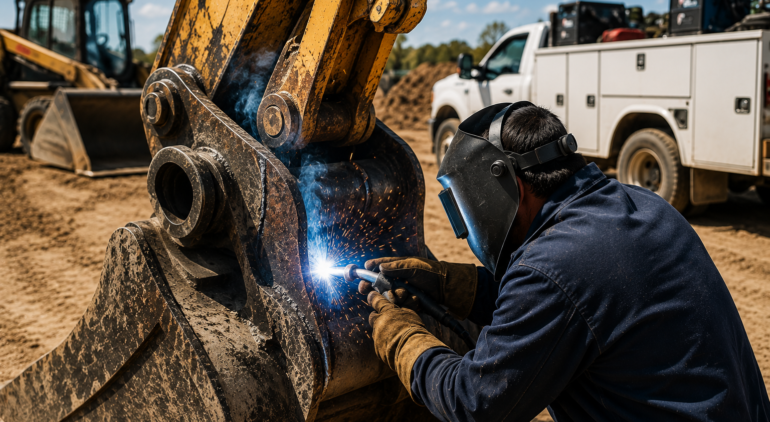
A properly equipped mobile welding rig brings professional welding capabilities directly to the jobsite, equipment yard, farm, plant, or business.
As Josh Forsberg of Montgomery Welding Services explains:
“When equipment goes down, our goal is simple: get to the customer, identify the problem, make the repair correctly, and help get that equipment back to work as quickly as possible.”
That approach is especially valuable when you’re dealing with equipment that is large, difficult to transport, or essential to keeping a project moving.
Skilled Welders Remain Essential
Modern equipment continues to become more advanced, but skilled welding remains an important part of construction, manufacturing, infrastructure, and equipment repair.
The U.S. Bureau of Labor Statistics reports that approximately 457,300 welders, cutters, solderers, and brazers held jobs in the United States in 2024. BLS projects about 45,600 openings each year, on average, between 2024 and 2034.
BLS also points to the nation’s aging infrastructure as one reason welders will continue to be needed for projects involving bridges, highways, buildings, machinery, and metal products.
Source: U.S. Bureau of Labor Statistics — Welders, Cutters, Solderers, and Brazers
The welding industry is particularly important here in Texas. BLS employment data shows that Texas had approximately 56,650 welders, cutters, solderers, and brazers in May 2024—the highest employment level of any state in the country.
Even closer to home, the Houston-Pasadena-The Woodlands metropolitan area had approximately 17,750, making it the metropolitan area with the highest employment level for the occupation in the nation.
Source: U.S. Bureau of Labor Statistics — Occupational Employment Data
There is a reason for that demand.
When steel cracks, bores wear out, brackets fail, or structural components are damaged, you need someone who understands more than how to lay down a weld. You need someone who understands the equipment, the application, and how the repaired component will perform when it goes back under load.
What Can Mobile Welding Help Repair?
Mobile welding can be useful across a wide range of construction and industrial applications.
Depending on the damage and equipment involved, on-site services can include repairs to heavy equipment, trailers, buckets, attachments, steel structures, pipe, brackets, frames, worn components, and other metal parts.
Specialized services such as line boring, bore welding, facing, drilling and tapping, machining, and ARC gouging can also address problems that go beyond a basic weld repair.
For example, worn pin and bushing bores can create excessive movement in heavy equipment. Ignoring that movement may allow the problem to become progressively worse.
Catching it early can make a major difference.
Should You Repair It Now or Keep Running It?
This is where equipment owners sometimes make an expensive mistake.
You notice a small crack. The machine still operates. The project is busy.
Do you stop now or try to finish the job?
Continuing to operate damaged equipment can turn a manageable repair into a much larger problem. A small crack can spread. A worn bore can continue wearing. Movement can damage surrounding components.
The cheapest repair is often the one performed before the damage gets worse.
Industry Tip
Make equipment inspection part of your regular routine. Pay particular attention to:
Cracks around welds and high-stress areas
Excessive movement around pins and bushings
Worn or elongated bores
Broken brackets or mounts
Bent or damaged steel
Unusual vibration, movement, or noise
If something doesn’t look right, have it inspected instead of assuming it can make it through another week.
The Right Repair Matters
Speed is important when equipment is down, but speed shouldn’t come at the expense of quality or safety.
The U.S. Bureau of Labor Statistics notes that welders can be exposed to occupational hazards including fumes, extremely hot materials, and intense arc light. Following proper safety procedures and using appropriate personal protective equipment are important parts of professional welding work.
Source: U.S. Bureau of Labor Statistics — Welding Work Environment and Safety
An experienced welder should evaluate the damaged area, determine the appropriate repair method, prepare the material correctly, and use a welding process suited to the application.
Depending on the project, that could include SMAW, GMAW, FCAW, GTAW, or another repair technique.
The objective isn’t simply making damaged metal look repaired.
The objective is creating a repair you can depend on when the equipment goes back to work.
Mobile Welding Across the Greater Houston Area
Construction and industrial work doesn’t always happen close to a repair shop.
Montgomery Welding Services provides mobile welding solutions for customers throughout Montgomery County, Conroe, The Woodlands, Magnolia, Spring, Houston, and surrounding areas.
Whether you’re dealing with heavy construction equipment, a trailer, structural steel, pipe, or another welding repair, bringing the welding service directly to your location can eliminate unnecessary transportation and help reduce valuable downtime.
And when your equipment makes your business money, every hour matters.
Need Mobile Welding or Equipment Repair?
Don’t wait for a small welding problem to become a major equipment failure.
Contact Montgomery Welding Services today to discuss your repair, fabrication, line boring, or mobile welding needs. We’ll come to your jobsite or equipment location, evaluate the problem, and work to get you back up and running.
Call: 832-955-7363
Email: montgomeryweldingservicesllc@gmail.com
Montgomery Welding Services — Quality welding solutions where you need them.