
Line Boring: What It Is and Why Heavy Equipment Needs It
Learn how line boring restores worn or damaged bores in heavy equipment.
Heavy equipment is built to handle demanding work, but it isn’t immune to wear.
Every time an excavator digs, a loader lifts, or a piece of construction equipment moves under a heavy load, tremendous force is transferred through its pins, bushings, and pivot points. Over thousands of operating hours, those areas can wear.
Eventually, a perfectly round bore may not be so round anymore.
That’s where line boring comes in.
For equipment owners and contractors throughout Montgomery County, Conroe, The Woodlands, Magnolia, Spring, and Houston, understanding line boring can help you recognize a problem early and potentially avoid more extensive equipment repairs later.
What Is Line Boring?
A bore is a precisely sized hole in a piece of equipment where a pin, shaft, or bushing fits.
You’ll find these connection points throughout excavators, loaders, dozers, backhoes, and other heavy equipment.
Over time, repeated movement and heavy loads can wear the inside of a bore. Instead of remaining round and properly aligned, it can become oversized, elongated, or misaligned.
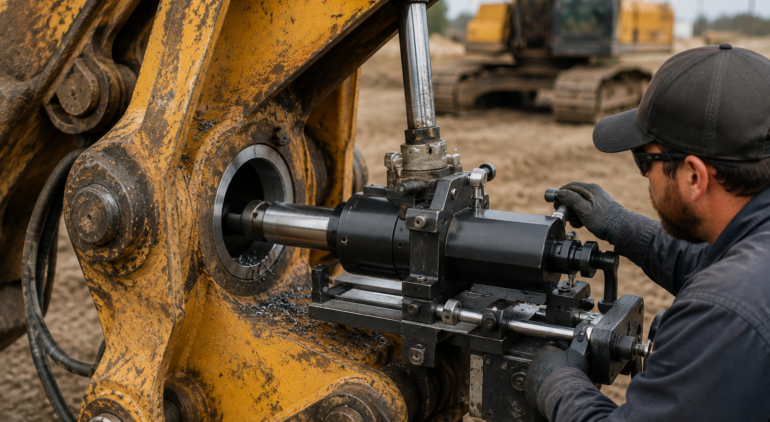
Line boring is a machining process used to restore those bores to the correct size and alignment.
In many repair situations, the worn area is first rebuilt through bore welding. New metal is added to replace material lost through wear. A line boring machine can then precisely machine the rebuilt bore back to the required diameter.
Think of it as rebuilding the connection point rather than simply putting another pin into a worn hole.
Why Do Heavy Equipment Bores Wear Out?
Heavy equipment operates under conditions that naturally create wear.
Pins and bushings repeatedly move against one another while carrying substantial loads. Dirt, debris, inadequate lubrication, worn bushings, and normal operating stress can accelerate the process.
Construction equipment operators themselves are responsible for some of the hardest-working machinery in the country. According to the U.S. Bureau of Labor Statistics, approximately 539,500 construction equipment operators held jobs in 2024. Nearly 58% worked in either specialty trade contracting or heavy and civil engineering construction.
Source: U.S. Bureau of Labor Statistics — Construction Equipment Operators
That equipment is expected to work day after day.
But consider this:
What happens when the pin and bushing are replaced, but the bore holding them is already worn?
The new components may not fit or operate as intended because the underlying mounting point is no longer within the proper dimensions.
How Do You Know a Bore Is Worn?
You don’t necessarily need to disassemble an entire machine to realize something isn’t right.
Operators often notice changes in how the equipment feels or performs.
Watch for excessive movement around pins and bushings, loose connections, uneven wear, unusual knocking or clunking, difficulty maintaining alignment, and visible wear around pivot points.
You may also notice that new pins or bushings don’t seem to eliminate the movement.
That’s an important warning sign.
As Josh Forsberg of Montgomery Welding Services explains:
“When a bore gets worn, replacing the pin or bushing doesn’t always fix the real problem. You have to look at the entire connection, measure the wear, and determine what needs to be restored so the equipment can operate correctly again.”
Why Proper Alignment Matters
Imagine two mounting points that are supposed to hold the same shaft.
If those bores aren’t properly aligned, the shaft or pin can experience uneven loading. That can contribute to premature wear and create additional stress on related components.
This is one reason line boring is precision work.
The goal isn’t simply to make the hole smaller or larger. The repaired bores need to be machined to the appropriate dimensions while maintaining the alignment required by the equipment.
That combination of welding and machining makes line boring different from a basic welding repair.
Industry Tip
Don’t judge bore condition by appearance alone.
Measurements matter. A bore that looks acceptable to the eye may already have enough wear to affect fit and alignment. When excessive play develops, have the connection inspected and measured before automatically replacing another set of pins and bushings.
Why Repair Instead of Replacing the Component?
Some heavy-equipment components are large, expensive, or difficult to replace.
Replacing an entire boom, bucket linkage, mounting assembly, or other major component because of worn bores may not always make economic sense when the damaged area can be professionally rebuilt.
Line boring provides another option.
The worn bore can potentially be welded, machined, and restored while the larger component remains usable.
For businesses, that can be especially important because equipment downtime has a cost.
BLS reports that construction equipment operators earned a median $58,320 annually in May 2024, while operators working in heavy and civil engineering construction earned a median wage of $61,710. When a critical machine stops working, the financial impact can extend beyond the machine itself to operators, crews, schedules, and other equipment waiting on the job.
Source: U.S. Bureau of Labor Statistics — Construction Equipment Operators
Line Boring Requires Welding and Machining Skills
A quality line boring repair involves more than operating one machine.
The technician needs to understand the condition of the metal, welding procedures, bore dimensions, alignment, machining, and how the repaired area functions under load.
The U.S. Bureau of Labor Statistics describes welders as workers who don’t simply join metal; their responsibilities can include reading specifications, calculating and measuring dimensions, inspecting materials, and maintaining equipment and machinery.
Source: U.S. Bureau of Labor Statistics — Welders, Cutters, Solderers and Brazers
The industry is particularly important in Texas. BLS data for May 2023 showed 52,820 welders, cutters, solderers, and brazers working in Texas, more than any other state. The Houston-The Woodlands-Sugar Land metropolitan area employed approximately 16,660, the highest employment level among U.S. metropolitan areas in that dataset.
That’s not surprising in a region built around construction, manufacturing, energy, heavy equipment, and industrial work.
Can Line Boring Be Done in the Field?
One of the biggest advantages of portable line boring equipment is the ability to perform certain repairs where the machine is located.
For large equipment, transporting a disabled machine to a repair facility can create another logistical problem.
Mobile service may allow the technician to bring the necessary welding and machining equipment directly to the jobsite, equipment yard, construction project, farm, or industrial facility.
For businesses in Montgomery County, Conroe, The Woodlands, Magnolia, Spring, Houston, and surrounding areas, that can make line boring an especially practical repair option.
Don’t Ignore Excessive Play
A little movement might not seem urgent.
But ask yourself: Why is that connection moving more today than it did six months ago?
Wear doesn’t usually correct itself.
If you notice excessive play, worn pins and bushings, elongated bores, poor alignment, or unusual movement in your heavy equipment, having the problem evaluated early can give you more repair options.
Need Line Boring or Bore Welding?
Montgomery Welding Services provides line boring, bore welding, mobile welding, heavy equipment repair, facing, drilling and tapping, machining, ARC gouging, and other specialized welding services.
If you’re dealing with a worn bore or excessive movement in your equipment, contact us to discuss the problem and determine the right repair solution.
Call: 832-955-7363
Email: montgomeryweldingservicesllc@gmail.com
Montgomery Welding Services — Quality welding solutions where you need them.