
7 Signs Your Heavy Equipment Needs Welding Repair
Learn how to recognize cracks, worn bores, damaged welds, and other warning signs before a small equipment problem turns into an expensive repair or unexpected downtime.
Heavy equipment takes a beating.
Excavators, loaders, dozers, skid steers, backhoes, and other construction equipment operate under tremendous loads, vibration, dirt, heat, and changing weather conditions. Eventually, something is going to wear.
The question is: Will you catch the problem before the machine stops working?
For contractors and equipment owners throughout Montgomery County, Conroe, The Woodlands, Magnolia, Spring, and Houston, recognizing the early signs of metal fatigue and component wear can mean the difference between scheduling a repair and dealing with an unexpected breakdown.
Here are seven warning signs worth watching.
1. Cracks Around Welds
One of the most obvious warning signs is also one of the easiest to overlook: a small crack.
Cracks can develop around buckets, brackets, booms, frames, attachments, and other high-stress areas. A hairline crack may not look serious today, but repeated loading and vibration can allow it to grow.
Caterpillar specifically recommends checking attachments for cracks during daily inspections. For buckets, operators should inspect for cracking, bowing, excessive wear, and pin and bushing wear.
Industry Tip: Clean dirt and grease from high-stress areas before inspecting them. A crack can be difficult to see underneath a layer of jobsite grime.
Source: Caterpillar — Excavator Maintenance Checklist
2. Broken or Deteriorating Welds
Not every welding problem begins with a dramatic failure.
Look for separation along a weld, visible cracking, excessive wear, or areas where the weld appears to be pulling away from the surrounding metal.
Caterpillar’s maintenance guidance specifically recommends inspecting equipment for cracks and broken welds and checking high-impact applications more frequently.
Think about the forces your equipment experiences every day. Digging, lifting, pushing, hammering, and carrying heavy material repeatedly load the same areas.
When was the last time you actually looked closely at the welds on your equipment?
A five-minute inspection today could identify something worth repairing before tomorrow’s job.
Source: Caterpillar — Ground Engaging Tool Selection and Maintenance
3. Excessive Movement Around Pins and Bushings
A little movement can become a big problem.
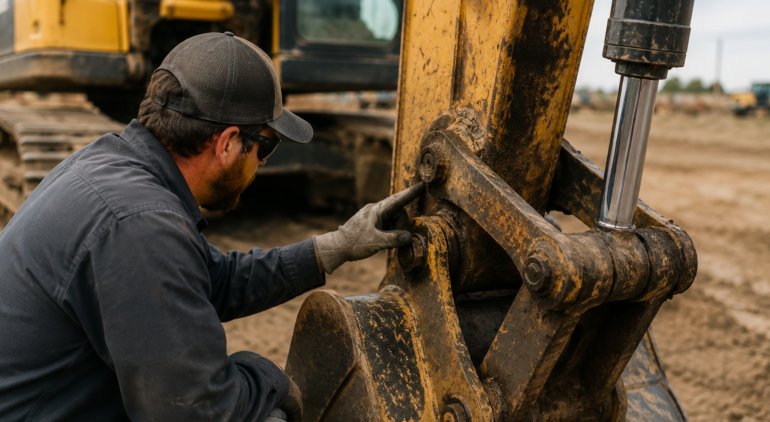
As pins, bushings, and bores wear, operators may begin noticing excessive play between components. You might see the bucket shift more than normal or notice movement where two components connect.
Caterpillar calls inspection of linkage pins and joints an important part of daily maintenance and recommends checking for damaged bolts, washers, plates, grease fittings, leaks, rust, and grease buildup.
Caterpillar also identifies lack of lubrication as the number-one cause of pin failure.
Once the bore itself becomes worn or elongated, replacing a pin or bushing may not solve the entire problem. Services such as line boring and bore welding may be necessary to restore the damaged area.
Source: Caterpillar — Inspecting and Greasing Linkage Pins
4. Unusual Noises While Operating
Your equipment can sometimes tell you something is wrong before you can see it.
Squeaking, knocking, clunking, or other unusual noises around a moving joint deserve attention.
Caterpillar recommends listening for unusual sounds during machine operation, noting that squeaky joints may indicate lubrication problems.
If something suddenly sounds different, don’t simply turn up the radio.
Stop and investigate.
A strange sound doesn’t automatically mean you need welding repair, but it can point you toward a worn joint or damaged component that needs attention.
5. Worn or Elongated Bores
Pins and bushings are designed to work within properly sized and aligned bores. Over time, wear can change the shape of those bores.
Instead of remaining round, a bore may become oversized or elongated.
You may notice loose pins, excessive movement, uneven wear, or difficulty maintaining proper alignment.
This is where specialized repair becomes important. Bore welding and line boring can rebuild and machine worn areas back to the dimensions required for proper fit and operation.
As Josh Forsberg of Montgomery Welding Services explains:
“A lot of equipment problems start small. If you catch a worn bore, crack, or damaged weld early, you usually have more options for repairing it before it damages other components or puts the machine completely out of service.”
6. Bent, Broken, or Damaged Metal Components
Heavy equipment isn’t exactly operated in a gentle environment.
Buckets hit rock. Attachments encounter unexpected loads. Trailers carry heavy equipment. Structural components experience thousands of load cycles.
Bent brackets, damaged plates, broken mounts, worn bucket components, and other visible metal damage should be evaluated rather than ignored.
Ask yourself a simple question:
Is this component performing the way it was designed to perform?
If the answer is no, continuing to work the equipment could potentially make the damage worse.
Depending on the component and extent of the damage, a professional welder may be able to repair, reinforce, fabricate, or replace the affected metal.
7. A Small Repair Keeps Getting Bigger
Maybe you already know something is wrong.
There’s a crack you’ve been watching. A bucket has more movement than it used to. A bracket is beginning to separate.
But the machine still works.
This is where procrastination can get expensive.
Preventive inspections are a fundamental part of heavy-equipment maintenance because early detection gives you an opportunity to address problems before they become major failures.
The demand for skilled welding also demonstrates how important these repairs remain. The U.S. Bureau of Labor Statistics reports that about 457,300 welders, cutters, solderers, and brazers held jobs in 2024, with approximately 45,600 openings projected each year through 2034. BLS specifically notes that welders remain important for machinery, metal products, buildings, highways, bridges, and America’s aging infrastructure.
Source: U.S. Bureau of Labor Statistics — Welders, Cutters, Solderers, and Brazers
Safety Should Always Come First
Welding repair isn’t simply about putting metal back together.
OSHA identifies welding hazards including metal fumes, ultraviolet radiation, burns, eye injuries, electrical shock, and other risks. Proper work practices and personal protective equipment are essential.
As OSHA’s guidance makes clear, many welding hazards can be controlled through appropriate procedures and PPE.
That is one reason equipment repairs should be properly evaluated instead of relying on a quick temporary fix just to get through another job.
Source: OSHA — Welding, Cutting and Brazing Hazards and Solutions
Don’t Wait for the Equipment to Break
Whether you’re running equipment in Conroe, The Woodlands, Magnolia, Spring, Houston, or elsewhere in Montgomery County, regular inspections can help you identify welding and wear problems before they cause unnecessary downtime.
Look closely. Listen to your machine. Pay attention when something changes.
And when you find a problem, address it.
Montgomery Welding Services provides mobile welding, heavy equipment repair, line boring, bore welding, fabrication, machining, ARC gouging, facing, drilling and tapping, and other welding solutions.
Need Your Equipment Inspected or Repaired?
If you’ve found a crack, worn bore, damaged weld, broken bracket, or another problem with your equipment, contact Montgomery Welding Services today. We can come directly to your jobsite or equipment location and help determine the right repair solution.
Call: 832-955-7363
Email: montgomeryweldingservicesllc@gmail.com
Montgomery Welding Services — Quality welding solutions where you need them.